Obedience Training: The Foundation of Every Guardian Dog
Obedience is the first and most important pillar of training for every dog in our program. Before a dog moves on to socialization work or protection training, it has to demonstrate reliable, consistent obedience, not just performing commands correctly once in a quiet room, but responding reliably in real-world conditions with real distractions. This foundation is what makes everything that follows possible.
This matters more than it might initially seem. A dog can look impressively well-behaved in a single demonstration and still be fundamentally unreliable in daily life if that behavior doesn’t hold up outside a controlled setting. We measure obedience training success by consistency across many different situations, not by isolated moments of good behavior.
Book a Free Consultation
What Real-World Obedience Actually Means
A dog that sits and stays perfectly in a training yard but ignores commands the moment something interesting happens hasn’t actually learned obedience. It’s learned to perform a trick under ideal conditions. Our obedience training deliberately introduces distraction and difficulty as a dog progresses: other people, other animals, unfamiliar environments, sudden noise, and competing stimuli like food or movement. A dog isn’t considered obedience-trained by our standards until it responds reliably even when it would rather do something else.
A Balanced, Structured Approach
Our obedience program is built on a balanced training philosophy rooted in classical conditioning: dogs learn fastest and most reliably when a specific behavior is paired, consistently and immediately, with a specific and predictable consequence, positive reinforcement when a command is executed correctly, and clear, fair correction when it isn’t. We don’t rely on a single, one-size-fits-all technique. Purely reward-based methods can produce a dog that performs beautifully with a treat in the room and falls apart without one, while heavy-handed, correction-only methods create a dog that complies out of avoidance rather than genuine understanding. Neither extreme produces the kind of dog we’re training for.
What we use instead is a structured, communication-first method: clear markers that tell a dog precisely which behavior earned a response, paired with consistent, predictable consequences on both ends of the spectrum. Over time, this builds a dog that isn’t guessing at what’s expected of it, it knows, with total clarity, and responds the same way whether it’s in a quiet training yard or a crowded, distracting environment. That clarity and consistency is what separates a dog that’s genuinely obedience-trained from one that’s simply food-motivated in a controlled setting.
Obedience as an Ongoing Relationship, Not a One-Time Achievement
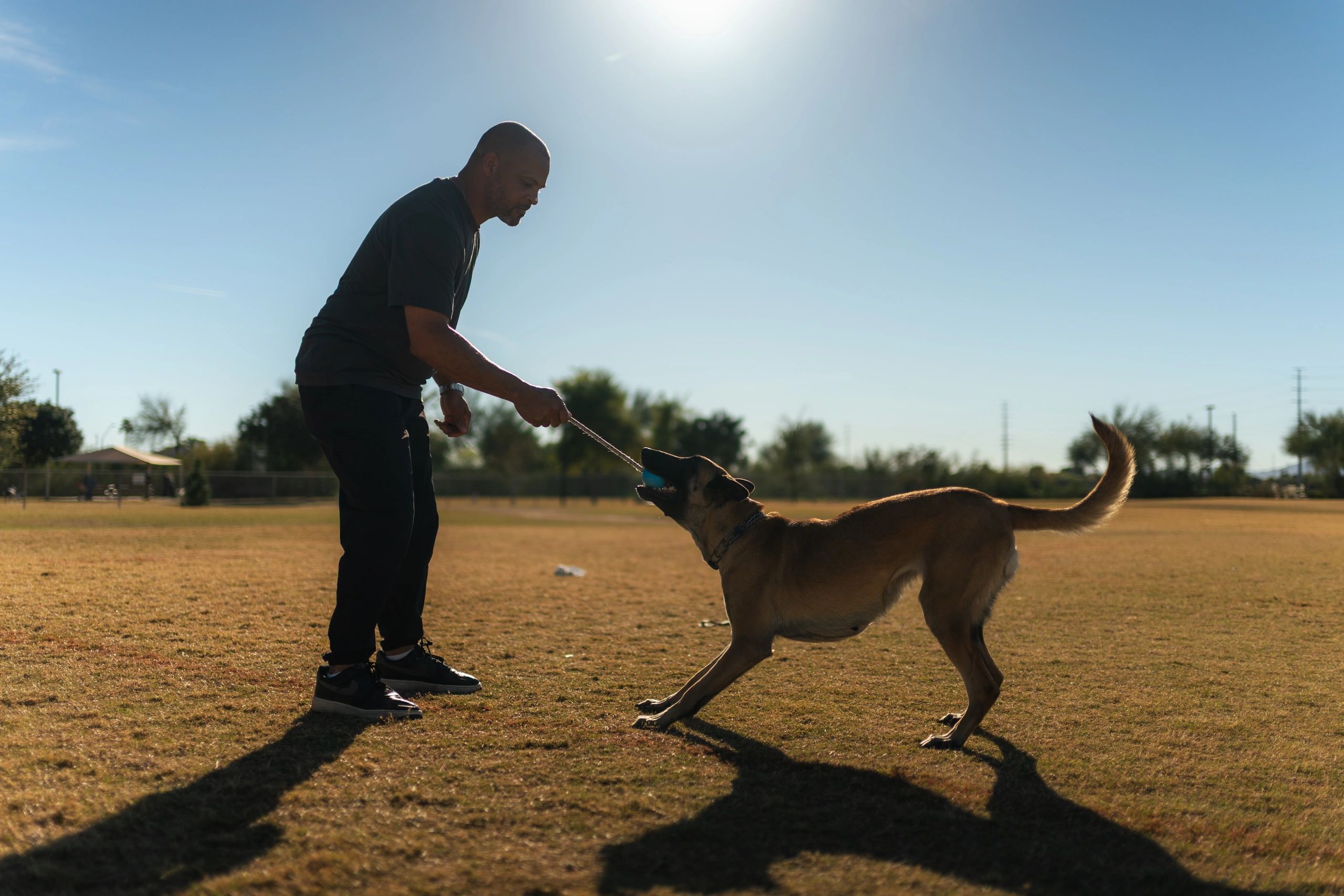
It’s worth emphasizing that obedience training isn’t a switch that gets permanently flipped on. Like any skill, it requires reinforcement to stay sharp. A dog that hasn’t practiced a command in months may respond more slowly or inconsistently than one reinforced regularly, which is exactly why we spend real time during transfer training teaching you not just the commands themselves, but how to maintain them going forward. The strength of your dog’s obedience six months or a year after delivery has as much to do with your consistency as it does with the training we provided.
Core Commands and Beyond
Every Guardian dog masters the fundamentals, sit, stay, come, heel, place, but our obedience program goes well beyond a basic command list. We train reliable off-leash control, calm behavior in public and crowded settings, impulse control around food and other animals, consistent recall even at a distance or under distraction, and a dog that consistently looks to its handler for direction rather than making independent decisions about how to respond to its environment.
Why Obedience Comes Before Everything Else
This sequencing is deliberate and non-negotiable in our program. A dog that begins protection-specific training without a rock-solid obedience foundation learns that its own instincts, not its handler’s direction, dictate its behavior, a dangerous habit in any dog, and especially dangerous in a dog selected for strong protective drive. By building obedience first, we ensure that everything trained afterward, including protection work, remains genuinely under your control rather than becoming an unpredictable instinct we’re hoping stays in check.
Obedience Across Different Breeds
While the core obedience curriculum is consistent across every dog in our program, the pace and approach can vary somewhat by breed and individual temperament. A German Shepherd’s strong desire to please often makes obedience training progress efficiently. A Belgian Malinois’s intensity means obedience work has to be especially thorough before moving forward, given how much drive needs to be channeled productively. A Dutch Shepherd’s independent streak sometimes calls for a slightly different motivational approach than a more naturally biddable breed. Our trainers adjust accordingly rather than applying an identical script to every dog.
How Long Obedience Training Takes
There’s no single number we can promise here, and we’d be doing you a disservice if we pretended otherwise. The obedience phase generally unfolds over a period of months rather than weeks, with the exact timeline shaped by a range of factors: the dog’s age at intake, any prior training (good or bad) it arrives with, individual temperament and drive, and how quickly that particular dog internalizes structure under real-world distraction. Every dog progresses at its own pace through this phase; we’d rather take the time a dog genuinely needs than rush a dog into the next stage of training before it’s ready.
Obedience Training Continues After Placement
Obedience isn’t something that’s finished the day your dog is delivered. It’s a relationship that continues for the life of the dog. During transfer training, we teach you how to maintain and reinforce the commands and structure your dog already knows, so the obedience foundation we built doesn’t erode once the dog is in a new environment with a new handler. Consistency on your end is what keeps that foundation solid long-term.
Questions About Our Training Standards?
If you’d like more detail on our obedience training methods or standards, contact us directly at 480-650-1650 or info@guardianprotectiondogs.com.
Book a Free Consultation